Media and journalism
To understand Umberto Eco, it is useful to begin with the idea of the professional intellectual: a figure who does not separate the professor from the columnist, the editorial executive from the militant critic, the author from the architect of the conditions of access to knowledge. For Eco, knowledge was not an aura nor an emanation of the spirit, but a trade—one to be practised, as he liked to say, "with hammer and chisel."
The workshop begins in Alessandria, at the Plana secondary school in the second half of the 1940s, among music, theatre and religion. With Gianni Coscia he experiments with registers and styles; in those same years he takes part in the activities of Catholic Youth and writes for the newspaper of Catholic Action, participating from within in the Catholic cultural world of the post-war period. That environment taught him not so much doctrine as the technique of discourse: how to argue, how to dispute, how to structure a text in order to persuade a community of readers. Here the posture of the militant critic is born—interpreter of the present rather than reviewer of works.
In 1954, at the age of twenty-two, he enters RAI through a national competition, joining the Directorate of Cultural Programming. Italian television is a newly formed institution (regular broadcasting begins precisely in 1954): no established durations, no genres, no formats.
Between 1954 and 1959, Eco takes part in what today we would call format engineering: it is not a matter of transmitting content, but of designing devices. In the same RAI building, at the Studio di Fonologia (1955–1960), Luciano Berio and Bruno Maderna edit magnetic tape as if it were musical phrasing; in the corridors circulate figures such as Piero Angela, Emmanuele Milano, Angelo Guglielmi, Fabiano Fabiani, Furio Colombo, Gianfranco Bettetini and Gianni Vattimo (among the so-called "Corsairs," led by Filiberto Guala), who, like Eco, are learning that culture can engage with technology without feeling diminished. It is in this laboratory that Eco understands that culture is not message but form, and that the audience is not a receiver but a participant, reader and consumer.
Open Work (1962) is the essay that most faithfully represents that experience: the work as a system, structure as producer of meaning, reception as co-production, consumption as fruition. A year later, Misreadings (1963) shows that the same device can be applied to journalism: the fragment not as residue of erudite knowledge but as a genre to be tested day by day.
From 1962 to 1972, in Milan, Eco collaborates with Il Giorno alongside Alberto Arbasino, Camilla Cederna, Pietro Citati, Giorgio Bocca, Ottiero Ottieri, Pier Paolo Pasolini and others.
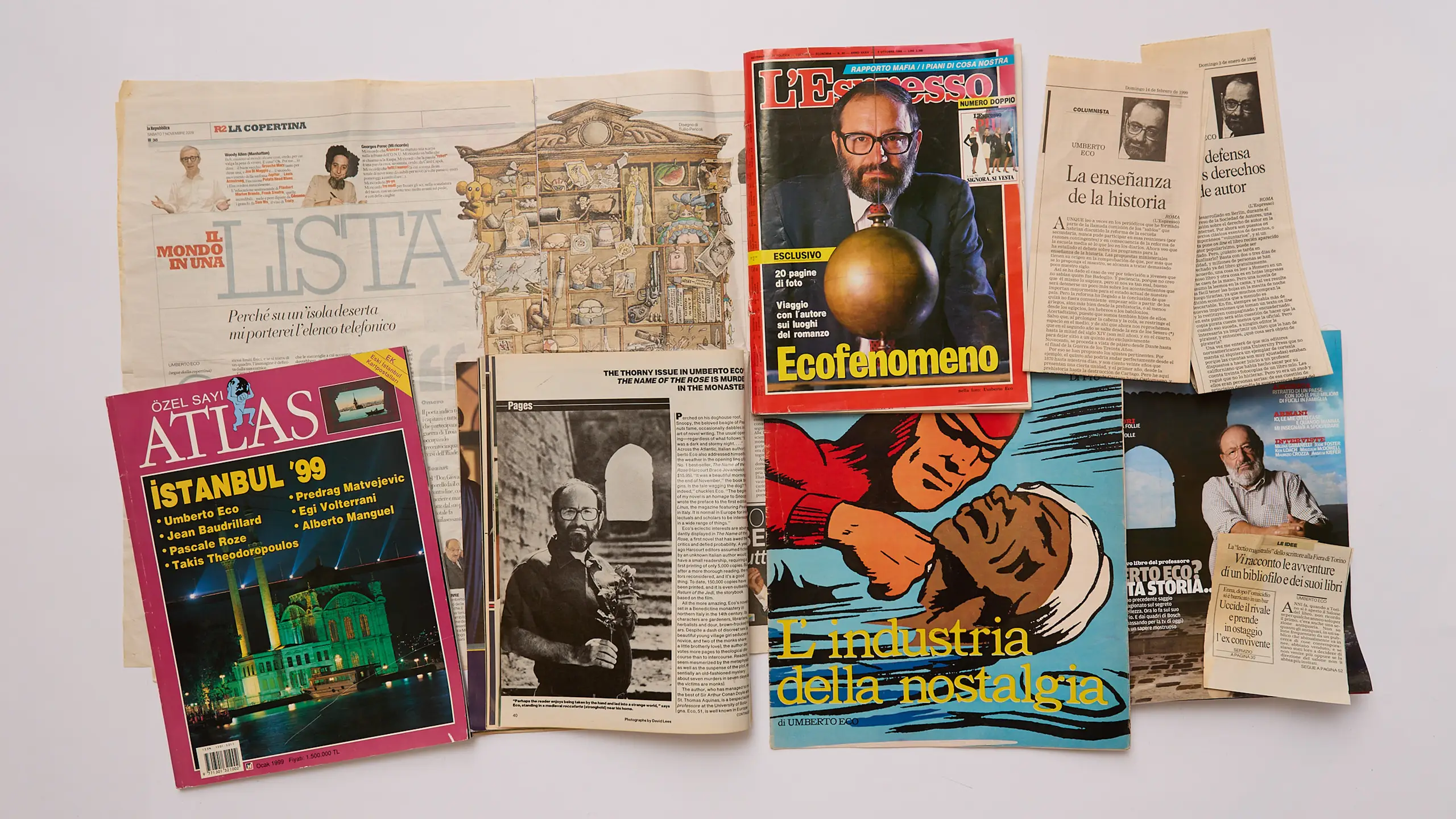
In the 1960s he contributes to Il Menabò and begins writing for L'Espresso, where he will later hold the celebrated column La bustina di Minerva (from 1985 to 2015); from 1963 he writes for Corriere della Sera; from 1971 to 1975 for Il Manifesto under the pseudonym "Dedalus"; in 1976 he joins the earliest stages of la Repubblica under Eugenio Scalfari—whom he already collaborates with at L'Espresso—helping to define the paper's cultural profile. He also writes in Alfabeta together with Antonio Porta, Maria Corti, Nanni Balestrini, Pier Aldo Rovatti, Francesco Leonetti, Paolo Volponi and, later, Omar Calabrese, Maurizio Ferraris, Germano Celant and others.
In similar fashion, his interventions for other outlets—L'Europeo, Paese Sera (1964), L'Unità (1967–1971), Il Secolo XIX, L'Avanti (1971), La Stampa, and Avvenire—should be read as dialogues with the Catholic world from which he originated, though now from the outside. Between 1989 and 1994 he also collaborates with La Rivista dei Libri, the Italian edition of the New York Review of Books directed by Furio Colombo, taking part in the rare Italian attempt to import longform criticism and the argumentative review. Meanwhile, articles and interviews appear in major international outlets: The New York Review of Books, The Guardian, Le Monde, El País, Der Spiegel, Die Zeit, Frankfurter Allgemeine Zeitung, Clarín. In all these places Eco is not a reporter: he is an interpreter. He does not explain facts; he contextualizes and assembles them within frameworks of meaning.
Viewed across the whole arc—from the 1940s in Alessandria, the 1950s at RAI, the 1960s between essay and reportage (including his masterful reports from the Prague Spring and from Latin America) and print journalism, the 1970s and 1980s in the most engaged cultural newsrooms during a season of genuine cultural militancy, the 1980s in the narrative of professions with the tangential yet never marginal commentary of his Bustine, the 1990s in the digital realm, and the 2000s in the return to print—a surprisingly continuous line emerges. Eco never thought of knowledge as accumulation, but as selection and filtering: television was not for him a tube that "informs," but a device that shapes the cognitive structure of content; social media—long before their existence—he foresaw as potentially global sports bars where every citizen feels entitled to express unfiltered opinions. This is the sense of his 2015 honorary degree speech in Turin, where Eco warns not against "idiots" but against the end of mediation and filters. It is the same logic that will operate in his work designing university programmes, first at DAMS and later at Communication Sciences, where semiotics and media theory do not serve to produce content but to form, describe and dismantle models of filtering and control of knowledge.